Daily Chemicals
-
Copper Tripeptide-1 CAS 130120-57-9阅读更多
Copper acetate peptide, also known as blue copper peptide. Copper peptide, also known as tripeptide in Chinese; Glycyl-L-histomyl-L-lysine. Peptide is a small molecule protein composed of amino acids, which are more easily absorbed by the skin and have more significant effects. It was first isolated from human plasma in 1973 and was discovered to have wound repair function in 1985. In 1999, researchers believed that copper peptide and its copper repair products can serve as activators of tissue remodeling, and it is also a signaling peptide, Promote the degradation of a large amount of collagen aggregates outside scars, the synthesis of normal collagen in the skin, the generation of elastin, proteoglycans, and glucosamine glycans, the growth rate and migration of different cell types, anti-inflammatory, and antioxidant responses.
-
D-Glucopyranose, oligomers, C12-14-alkyl glycosides CAS#157707-88-5阅读更多
Alkyl glucoside, AlkylPolyglucoside(APG). It is formed by the dehydration of glucose hemiacetal hydroxyl group and fatty alcohol hydroxyl group under catalytic action. Alkyl glycoside (APG) is a new type of highly efficient, non-toxic, biodegradable non-ionic surfactant with good surface activity. The raw materials required for its production are glucose and fatty alcohol derived from renewable natural resources. The combination can form the best surfactant at present. Strong foaming power, foam stability, good wettability, excellent compatibility, little irritation to the human body, extremely low toxicity, rapid biodegradation, is the only variety in the world that can be called non-toxic, therefore, APG is known as “world-class” surfactants with its superior performance. Alkyl glycosides can be used in daily chemical industry, textile industry, pesticide industry, food industry, oil production industry and so on.
-
Decamethylcyclopentasiloxane CAS #541-02-6阅读更多
Decamethylcyclopentasiloxane (D 5) is a silicone compound with the molecular formula of [(CH 3) 2SiO] 5. It is a colorless and tasteless liquid with slight volatility.
Cyclopentasiloxane CAS No. 541-02-6, chemical formula C10H30O5Si5, molecular weight 370.77000, Chinese alias decamethylcyclopentasiloxane, liquid, boiling point 90 ??C10 mm Hg(lit.), flash point 162 ??F, density 0.958 g/mL at 25 ??C(lit.), refractive index n20/D 1.396(lit.). Decamethylcyclopentasiloxane (cyclopentasiloxane) is a colorless, odorless, volatile liquid cyclic siloxane, safe and environmentally friendly, and has been widely used in health and beauty products , such as deodorants, antiperspirants, cosmetics, shampoos, body lotions, etc. Good compatibility with alcohol and most other cosmetic solvents.
-
Decyl glucoside CAS#68515-73-1阅读更多
Decyl Glucoside is an eco-friendly, non-ionic surfactant derived from renewable resources. Renowned for its mildness and biodegradability, it is ideal for creating gentle, high-performing cleaning agents in personal care and household products. Its sustainable and effective nature makes it a preferred choice for green formulations.
-
Decyl glucoside CAS#68515-73-1阅读更多
Decyl glucoside, scientifically known as ??-D-Glucopyranoside, is a non-ionic surfactant derived from renewable resources, such as glucose and fatty alcohols. It is a biodegradable and mild alternative to traditional surfactants, making it a preferred choice for eco-friendly and sensitive skin formulations.
This compound is characterized by its ability to form stable emulsions and foams, which are essential properties in a variety of applications, including personal care products and household cleaning agents. Decyl glucoside is valued for its low irritation potential and excellent skin compatibility, making it suitable for use in baby care and cosmetic products.
Chemically, decyl glucoside features a hydrophilic head and a hydrophobic tail, allowing it to effectively reduce surface tension and solubilize oils in water. Its mildness and biodegradability contribute to its use in formulations that require gentle cleansing without compromising the integrity of the skin’s natural barrier.
In summary, decyl glucoside is a versatile and sustainable surfactant that offers a balance of performance and safety. Its eco-friendly profile and compatibility with sensitive skin types make it an ideal ingredient for a wide range of personal care and cleaning products.
-
Decyl glucoside CAS#68515-73-1阅读更多
Decyl glucoside, scientifically known as ??-D-Glucopyranoside, is a non-ionic surfactant derived from renewable resources, such as glucose and fatty alcohols. It is a biodegradable and mild alternative to traditional surfactants, making it a preferred choice for eco-friendly and sensitive skin formulations.
This compound is characterized by its ability to form stable emulsions and foams, which are essential properties in a variety of applications, including personal care products and household cleaning agents. Decyl glucoside is valued for its low irritation potential and excellent skin compatibility, making it suitable for use in baby care and cosmetic products.
Chemically, decyl glucoside features a hydrophilic head and a hydrophobic tail, allowing it to effectively reduce surface tension and solubilize oils in water. Its mildness and biodegradability contribute to its use in formulations that require gentle cleansing without compromising the integrity of the skin’s natural barrier.
In summary, decyl glucoside is a versatile and sustainable surfactant that offers a balance of performance and safety. Its eco-friendly profile and compatibility with sensitive skin types make it an ideal ingredient for a wide range of personal care and cleaning products.
-
Decyl glucoside CAS#68515-73-1阅读更多
Decyl Glucoside is an eco-friendly, non-ionic surfactant derived from renewable resources. Renowned for its mildness and biodegradability, it is ideal for creating gentle, high-performing cleaning agents in personal care and household products. Its sustainable and effective nature makes it a preferred choice for green formulations.
-
Deoxyarbutin CAS# 53936-56-4阅读更多
Deoxyarbutin (CAS 53936-56-4) is usually a white to off-white powder.
Deoxyarbutin is a highly effective whitening ingredient. Its effect in inhibiting melanin production is significantly better than traditional arbutin.
In cosmetics, deoxyarbutin is often added to whitening skin care products to help reduce spots and brighten skin tone. For example, some high-end whitening essences, creams and other products will use deoxyarbutin to achieve better whitening effects.
However, when using products containing deoxyarbutin, you need to pay attention to the possible adverse reactions such as skin irritation, especially for people with sensitive skin. -
Dimethyl Sulfide CAS #75-18-3阅读更多
Methyl sulfur has the unpleasant smell of wild radish, similar to cabbage. Only at very low levels (0.1 ?C 3.0 ppm) can it be tolerated as a green vegetable flavor. It can be prepared by the reaction of potassium sulfide and methyl chloride in methanol solution; From potassium methyl sulfate and potassium sulfide.
Dimethyl sulfide (DMS) or methyl thiomethane is an organic sulfur compound with the molecular formula (CH 3) 2 s. Dimethyl sulfide is a flammable liquid that boils at 37 ?? C (99 ?? f) and has an unpleasant odor. It is a component of the smell produced by certain vegetables (especially corn, cabbage, beetroot and seafood) during cooking. This is also a sign of bacterial contamination during malt production and brewing. It is the decomposition product of dimethylsulfopropionic acid (DMSP) and methyl mercaptan produced by bacterial metabolism.
-
Dioctyl Sebacate CAS# 122-62-3阅读更多
Dioctyl sebacate, also known as bis-2-ethylhexyl sebacate, referred to as DOS, is produced by the esterification reaction of sebacic acid and 2-ethylhexanol. Suitable for polyvinyl chloride, vinyl chloride copolymer, nitrocellulose, ethyl cellulose and synthetic rubber, etc. It has high plasticizing efficiency and low volatility. It has excellent cold resistance, good heat resistance, light resistance and electrical insulation. It also has good lubricity when heated, making the product look and feel good, especially Suitable for making cold-resistant wire and cable materials, artificial leather, films, plates, sheets, etc.
-
Dodecyl Dimethyl Benzyl Ammonium Chloride CAS #122-19-0阅读更多
Stearic dimethyl benzyl ammonium chloride is a white solid or viscous liquid with slight odor.
Synthesis of benzyl dimethyl stearyl ammonium chloride: put 450kg dimethyl octadecylamine into a reactor, heat it to 80~85 ??, and slowly add 180kg benzyl chloride within 1.5~2h under stirring. The temperature shall be kept at 80~90 ?? during the dropping process. After dosing, temperature rise to 100~105 ??, keep the reaction for several hours, and take samples to determine the pH value. When the pH value of 1% aqueous solution reaches 6~6.5, the reaction is completed. Lower the temperature to 60 ?? and discharge to obtain benzyl dimethyl stearyl ammonium chloride.
-
Dodecylbenzenesulphonic acid CAS# 27176-87-0阅读更多
Dodecylbenzenesulphonic acid(DBSA) can be used as a catalyst for the esterification of fatty acids (oleic acids) to produce biodiesel. It can be used as a Bronsted acid catalyst for the green synthesis of quinoxaline derivatives which are used in a variety of pharmacological profiles. It may be electrodeposited with polypyrrole(PPy) films on the aluminium alloy to protect against corrosion. Water based nanofluids with enhanced thermal conductivity and specific heat capacity may be prepared by doping polyanaline (PANI) into dodecylbenzenesulphonic acid. Dodecylbenzenesulphonic acid is also a dopant for conducting polymers and a strong acid catalyst for amino crosslinked coatings.
-
EC 3.4.21.14 CAS#9014-01-1阅读更多
EC 3.4.21.14, previously classified, now redirects to EC 3.4.21.67, identifying endopeptidase So. This serine endopeptidase is integral in the hydrolysis of peptide bonds, a critical function in biological systems. Its applications extend across research and development in the pharmaceutical and biotechnological industries.
-
EC 3.4.21.14 CAS#9014-01-1阅读更多
EC 3.4.21.14, previously classified, now redirects to EC 3.4.21.67, identifying endopeptidase So. This serine endopeptidase is integral in the hydrolysis of peptide bonds, a critical function in biological systems. Its applications extend across research and development in the pharmaceutical and biotechnological industries.
-
Ectoine CAS#96702-03-3阅读更多
Ectoine is a naturally occurring osmoprotectant, a cyclic amino acid derivative that offers exceptional cell-stabilizing properties. Highly valued in cosmetics and pharmaceuticals, it enhances product efficacy by maintaining cell integrity under various environmental stresses.
-
Ectoine CAS#96702-03-3阅读更多
Ectoine is a naturally occurring osmoprotectant, a cyclic amino acid derivative that offers exceptional cell-stabilizing properties. Highly valued in cosmetics and pharmaceuticals, it enhances product efficacy by maintaining cell integrity under various environmental stresses.
-
Ectoine CAS#96702-03-3阅读更多
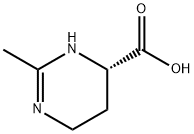
Ecdoine is also called tetrahydromethylpyrimidine carboxylic acid. Ectoin can protect halophile bacteria from harm, it has two functions: 1) moisturizing: it is an important substance to maintain osmotic pressure balance, its unique molecular structure has a strong water molecular complexation ability, can make the free water in the cell structure, is a very excellent natural moisturizer. 2) Repair: Ecdoin can fight against UV damage to the skin and repair DNA damage caused by UV.
-
Ethyl 2-cyano-3,3-diphenylacrylate CAS#5232-99-5阅读更多
Ethyl 2-cyano-3,3-diphenylacrylate is a key synthetic intermediate in the pharmaceutical and agrochemical industries. This compound, with its reactive cyanoacrylate structure, offers unique opportunities for chemical synthesis, providing a robust platform for the development of innovative products.
-
Ethyl 2-cyano-3,3-diphenylacrylate CAS#5232-99-5阅读更多
Ethyl 2-cyano-3,3-diphenylacrylate is a key synthetic intermediate in the pharmaceutical and agrochemical industries. This compound, with its reactive cyanoacrylate structure, offers unique opportunities for chemical synthesis, providing a robust platform for the development of innovative products.
-
Ethyl Cellulose CAS# 9004-57-3阅读更多
Ethyl ester of cellulose. White to light gray liquid paste, thermoplastic. It is unpredictable to heat, modifications shade and also sheds its original physical as well as chemical residential or commercial properties at high temperature (240 ?? C). Viscosity should be specified for commercial quality items. The relative thickness is 1.07-1.18, the refractive index is 1.47, as well as the softening factor is 100-130 ?? C. It can develop difficult movies and also preserve flexibility at low temperatures. Can be blended with resins, waxes, oils, and so on. Stable to alkali as well as thin down acid.