

Copper Tripeptide-1 CAS 130120-57-9


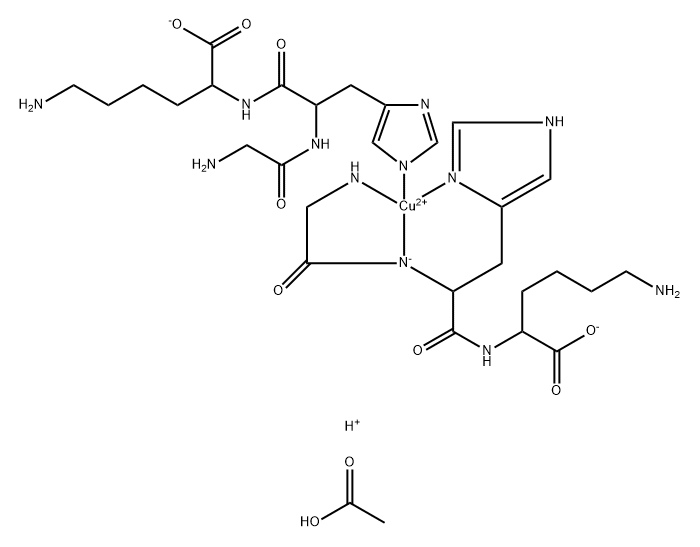
Copper acetate peptide, also known as blue copper peptide. Copper peptide, also known as tripeptide in Chinese; Glycyl-L-histomyl-L-lysine. Peptide is a small molecule protein composed of amino acids, which are more easily absorbed by the skin and have more significant effects. It was first isolated from human plasma in 1973 and was discovered to have wound repair function in 1985. In 1999, researchers believed that copper peptide and its copper repair products can serve as activators of tissue remodeling, and it is also a signaling peptide, Promote the degradation of a large amount of collagen aggregates outside scars, the synthesis of normal collagen in the skin, the generation of elastin, proteoglycans, and glucosamine glycans, the growth rate and migration of different cell types, anti-inflammatory, and antioxidant responses.
Copper Tripeptide-1 CAS 130120-57-9
| Prezatide copper acetate Basic information |
| Product Name: | Prezatide copper acetate |
| Synonyms: | Prezatide copper acetate;GHK-Cu, >=98%;Copper peptide, Copper Tripeptide-3, AHK Copper;Anti-allergic & Skin Repair Series AHK – Cu /GHK-Cu/ Copper Peptide;Copper Tripeptide-3 (AHK-Cu);Tripeptide-1 copper (copper peptide);Pure copper peptide ghk-cu/ghk cu copper tripeptide-1 prezatide copper acetate;copper,aceticacid,(2S)-6-amino-2-[[(2S)-2-[(2-aminoacetyl)amino]-3-(1H-imidazol-5-yl)propanoyl]amino]hexanoicaci |
| CAS: | 130120-57-9 |
| MF: | C30H48CuN12O10 |
| MW: | 800.33 |
| EINECS: | 000-000-0 |
| Product Categories: | APIs;130120-57-9 |
| Mol File: | 130120-57-9.mol |
 |
|
| Prezatide copper acetate Chemical Properties |
| InChIKey | VJKXESGORYEAGC-UHFFFAOYSA-K |
| SMILES | C(=O)(O)C.C(C1CC2=CNC=N2[Cu+2]2(N3C=NC(CC(NC(=O)CN)C(=O)NC(C(=O)[O-])CCCCN)=C3)NCC(=O)[N-]12)(=O)NC(C(=O)[O-])CCCCN.[H+] |
| LogP | -2.241 (est) |
| Safety Information |
| MSDS Information |
| Prezatide copper acetate Usage And Synthesis |
| Description | Iamin gel was launched in the US for the care of chronic and acute wounds. It can be prepared by combining the tripeptide GHK and copper (??) acetate. There are several species present in equilibrium but the biscomplex is the dominant compound at neutral pH. The GHK sequence is found in only eight human proteins and is an endogenous growth factor that stimulates collagen synthesis and angiogenesis. This is part of the explanation for its wound healing and tissue repair ability. It can significantly delay fibroblast activation, is a growth factor for hepatocyctes, neurons, thyroid follicular cells and is a chemoattractant for monocytes, macrophages, mast cells and capillary endothelial cells. Copper is also known to have an effect on lysyl oxidase which is a key enzyme involved in collagen formation. |
| Originator | ProCyte (USA) |
| Uses | anti-wrikle |
| Uses | Prezatide is used for skin care, and has the potential to treat chronic obstructive pulmonary disease and metastatic colon cancer. Prezatide copper acetate is used in personal skin care products with anti-inflammatory and anti-allergic effects, such as essence lotion, cream, facial mask and sunscreen, etc |
| Brand name | Iamin (ProCyte). |
| Mechanism of action | Copper peptides, including Prezatide, are known for their potent biological activity, primarily due to copper’s essential role in various enzymatic processes. In wound healing, Prezatide copper acetate promotes angiogenesis (the formation of new blood vessels), which is critical for supplying nutrients and oxygen to the wound site. This process is facilitated by activating growth factors such as vascular endothelial growth factor (VEGF) and transforming growth factor-beta (TGF-??). Additionally, Prezatide copper acetate exhibits significant anti-inflammatory properties. It inhibits the production of pro-inflammatory cytokines, thereby reducing inflammation and promoting a conducive environment for tissue repair. The compound also boosts the synthesis of extracellular matrix components like collagen and elastin, which are vital for maintaining skin integrity and elasticity, thus explaining its use in dermatological applications. |
| Side effects | Commonly reported side effects from topical application include skin irritation, redness, and itching at the site. These are generally mild and tend to resolve with continued use or after product discontinuation. More severe allergic reactions are rare but can occur, manifesting as swelling, severe itching, or difficulty breathing, which would require immediate medical attention. Systemic administration of Prezatide copper acetate may present a different side effect profile. Patients could experience symptoms such as nausea, vomiting, headache, dizziness, and, in some cases, gastrointestinal disturbances. Due to the involvement of copper, there is also a potential risk of copper toxicity, particularly in patients with underlying conditions that affect copper metabolism, such as Wilson??s disease. Therefore, it is crucial to monitor copper levels in the body during treatment. |
Related Products
Chemical Name: Dehydrocholic acid
Synonyms: Acide dehydrocholique; Triketocholanic acid
CAS No.: 81-23-2
Molecular Formula: C24H34O5
Molecular Weight: 402.53
Appearance: Powder

Chemical Name: N-Acetyl-D-mannosamine
Cas: 7772-94-3
MF: C8H15NO6
MW: 221.21
Appearance: White to off-white powder

Chemical Name: STODDARD SOLVENT
CAS No.: 64742-88-7
Appearance: Colorless or Light Yellow Liquid
EC 3.4.21.14, previously classified, now redirects to EC 3.4.21.67, identifying endopeptidase So. This serine endopeptidase is integral in the hydrolysis of peptide bonds, a critical function in biological systems. Its applications extend across research and development in the pharmaceutical and biotechnological industries.
Product name: Cholesterol Esterase
Synonyms: Biocatalytics E3; Bucelipase alfa; Sterol esterase
CAS No.: 9026-00-0

Chemical Name: o-Xylene
Synonyms: 1,2-Dimethylbenzene; ortho-xylene
CAS No.: 95-47-6
Molecular Formula: C8H10
Molecular Weight: 106.17

Polyglutamic acid (CAS 25513-46-6) is usually in the form of white powder.
Polyglutamic acid is a high molecular compound with good water solubility and biocompatibility.
It has many excellent properties, such as water retention, plant growth promotion, and improved fertilizer utilization. In the agricultural field, it can be used as a fertilizer enhancer, water retainer, etc., which helps to improve the fertility and water retention capacity of the soil and promote the growth and development of crops. For example, adding it to fertilizer can reduce fertilizer loss and improve the effect of fertilizer.
In the field of cosmetics, polyglutamic acid is also used, because its moisturizing properties can be used in skin care products.
Chemical Name: beta-NADH disodium salt
Other name: beta-Nicotinamide adenine dinucleotide disodium salt
CAS No.: 606-68-8
Molecular Fomula: C21H30N7NaO14P2
Molecular weight:?689.44
Appearance:?white to light yellow powder
Assay: 95%min

Chemical Name:?UDP-Glucuronic Acid Trisodium
CAS No.: 63700-19-6
Molecular Fomula: C15H23N2NaO18P2
Molecular weight: 604.28
Appearance: Solid
Assay: 98%

Chemical Name: 1,1,2,2-Tetrachloroethane
Other Name: Tetrachlorethane
CAS No.: 79-34-5
Molecular Formula: C2H2Cl4
Molecular Weight: 167.85
Appearance: Liquid

Ectoine is a naturally occurring osmoprotectant, a cyclic amino acid derivative that offers exceptional cell-stabilizing properties. Highly valued in cosmetics and pharmaceuticals, it enhances product efficacy by maintaining cell integrity under various environmental stresses.
Chemical Name: Zinc citrate
Synonyms: Zinc citrate trihydrate
CAS No.: 546-46-3
Molecular Formula: C6H8O7Zn
Molecular Weight: 257.5
Appearance: White powder


